
The contractor's review desk
Monthly billing does not tell you when cash arrives
Review what permits billing, what supports the request, who must approve it, and what releases retained amounts before committing to an estimate.
A billing interval is one fact. The conditions around it are another.
When reviewing a public construction or facilities bid, avoid reducing payment terms to one label in the estimate. The useful question is what must happen before each request can be made, processed and paid. Keep those conditions beside their sources so the person reviewing the commercial assumptions can see what remains unresolved.
This is a contract-review method, not a payment forecast or a promise of collection. The federal construction clauses below are examples. Review state, local and agency-specific requirements in the documents that actually apply; do not import a familiar percentage or deadline.
Separate billing, approval and release
Start by identifying the kind of payment being described. A progress request, a request for retained amounts and final payment can have different conditions. Put each in a separate record when the contract treats them separately. A statement about one should not silently become an assumption about another.
Then read around the frequency or milestone. Look for required records, submission instructions, review, certification or acceptance language. Preserve the relationship between the trigger and its conditions instead of copying only the most convenient phrase into a pricing note.
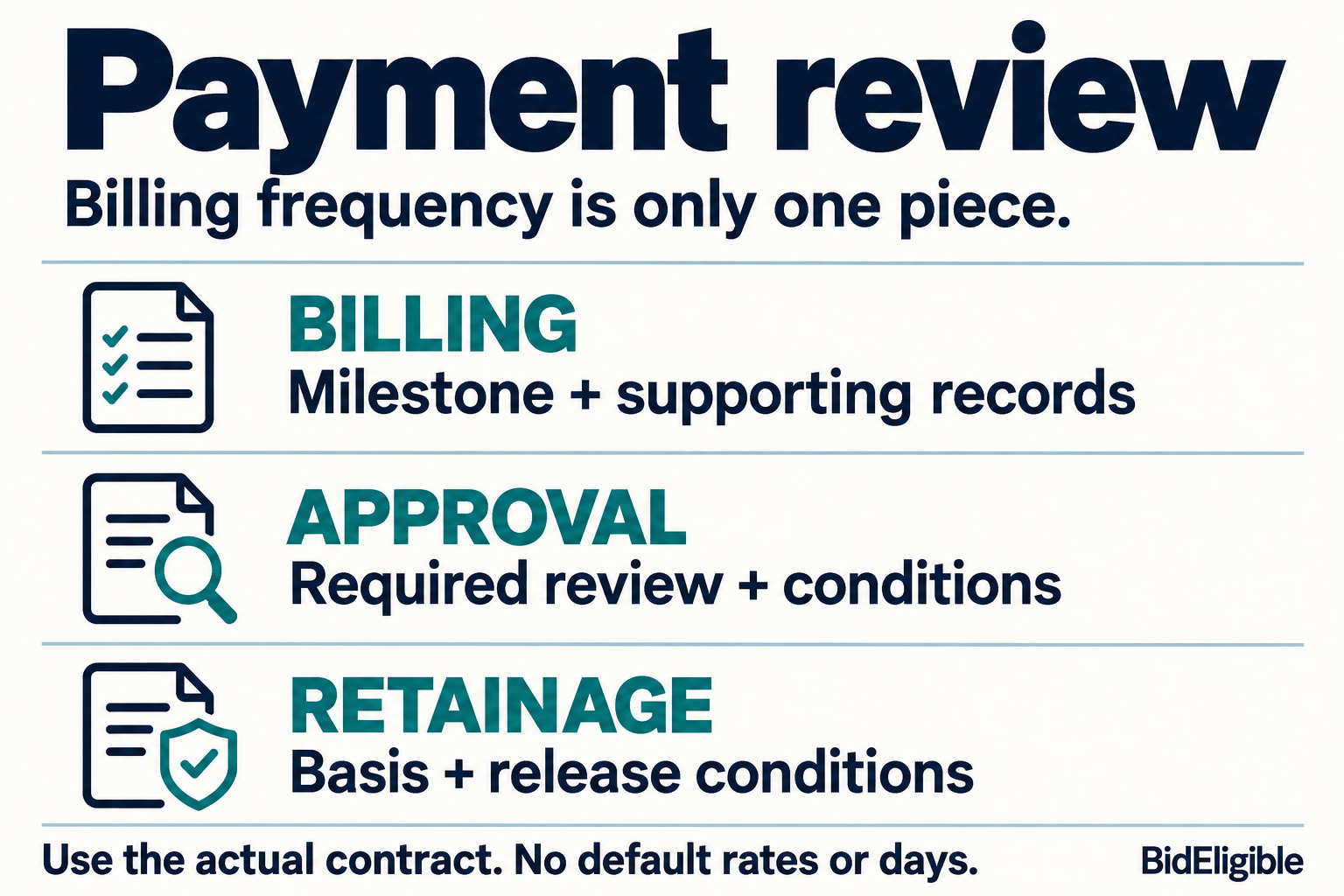
Make the payment assumption checkable
Use a short record that another team member can trace without relying on the original reader's memory. Keep the following fields with each payment provision rather than treating the table as a list of conditions that every contract must contain.
| Field | Review question |
|---|---|
| Billing milestone | What work or event permits a request, and which type of payment is being requested? |
| Supporting records | Which itemization, certification, form or other record must accompany that request? |
| Review and approval | Who receives or reviews it, and what approval or acceptance condition does the contract state? |
| Retainage | What basis and withholding conditions are stated, and what event or approval permits release? |
| Source and open item | Keep the document, clause, page or section, amendment, unanswered question and responsible reviewer together. |
Record a stated retainage percentage together with its calculation basis and release conditions. If one of those details cannot be found, leave an open item. A known rate does not establish a known release date. Do the same for any final-payment condition that remains to be reviewed.
Read the applicable clause, not a remembered rule
FAR 52.232-5 connects progress-payment requests to substantiation, certification and approval of work estimates. It also addresses retained amounts and final payment. These details illustrate why a billing interval alone is an incomplete review record.
FAR 52.232-27 distinguishes payment types and ties timing to the applicable request and approval conditions. To review your contract, retain both the time period and the event that starts it. This guide supplies no default number of payment days.
GSAM 552.232-5 adds GSA-specific payment-request, documentation and closeout requirements where applicable. Do not assume those agency forms or processes govern another project simply because both projects involve public construction.
Check the clauses incorporated into the actual package, their completed wording and relevant amendments. A familiar clause title does not replace reading the current text. If applicability or conflicting provisions remain unclear, preserve the issue for the designated contact or appropriate commercial or professional reviewer.
Give open payment questions an owner
Before committing to pricing assumptions, ask a second reviewer to trace each payment note back to its source. Can that person identify the payment type, required support and stated conditions? If the answer depends on an unread attachment, keep that attachment visible as a gap.
Assign the open item to someone and set an internal follow-up date that respects the actual question deadline. Record the answer and its authority beside the original provision. Do not treat a team member's expectation or a past project's practice as a clarification from the owner.
Finally, recheck amendments before submission. Keep a material change connected to the estimate or review note it affects. This creates a useful handoff between the person reading the bid, the estimator and the person responsible for commercial review.
Review your own bid package
Bring one supported document or a public official bid link that requires no login to BidEligible. Review the available findings and their citations, then check coverage and unresolved items. A completed file-reading task does not establish that every payment condition was found or approved.