
The contractor's review desk
Before you call your surety, make “bond required” specific
Separate the obligation from the label. Gather the amount, form, timing and source before you ask someone to arrange a bond.
“Bond required” is a useful flag. It is not enough information to prepare a bid.
Before you ask someone to arrange a bond, identify the exact obligation in the current solicitation. Then record its amount or calculation, required form, delivery instructions and deadline. Keep a source reference beside every field. A blank field belongs on the question list, rather than being filled from memory.
This is a review method for contractors. The federal terminology below provides examples; state, local and agency-specific requirements must be checked in their own documents.
First, separate the checks
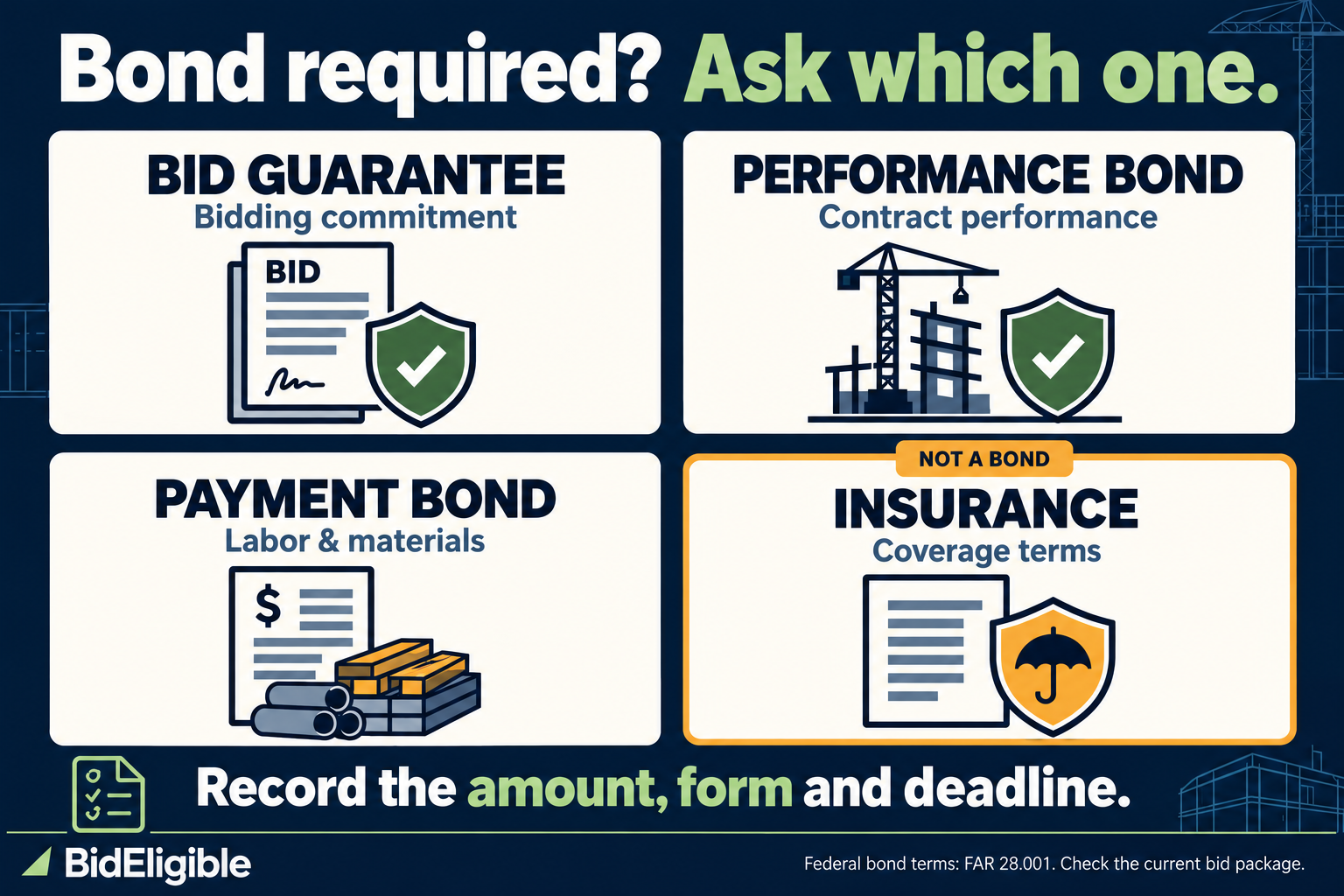
Under FAR 28.001, a bid guarantee addresses the bidder's commitment during acceptance and, if selected, execution of the contract and furnishing required bonds. A performance bond concerns fulfillment of contract obligations. A payment bond concerns payments to those supplying labor or material for the work.
Those are different questions. Keep insurance requirements in their own row too, so policy coverage is not substituted for a bond requirement. The infographic provides a quick vocabulary aid; the actual provision and form contain the operative details.
Build a requirement record before making the request
Use one row for each stated obligation. Start with these fields:
| Field | What to capture |
|---|---|
| Type | The exact guarantee, bond or insurance requirement named in the package |
| Amount | Stated dollars, percentage, limits and calculation basis |
| Form | The required form or acceptable instrument, including supporting documents |
| Timing | When proof or the executed instrument must be received |
| Delivery | Submission channel, recipient and any stated handling instructions |
| Responsibility | Who will arrange it and who will verify the final submission |
| Evidence | Document name, clause, page or section, and amendment reference |
| Open item | What is missing, who will resolve it and the internal follow-up date |
Preserve relationships between numbers. A percentage, a dollar figure and a phrase describing which controls should remain together. Copying only the largest number into an estimate can leave the instruction incomplete.
Read the required form, amount and timing together
FAR 52.228-1 illustrates why these details matter: an improper guarantee, amount or submission time can lead to rejection. Its amount language pairs a percentage with a dollar figure and uses the lesser value. Read the completed values in the actual solicitation; this article supplies no default percentage for your bid.
For the review workflow, keep all those details in the same record. If a required value or form cannot be located, retain that gap. A checklist entry saying “yes” should not hide an unanswered question about what must be delivered.
Send the source, not just a summary
Prepare a short request package for the responsible surety professional or broker: the requirement record, the actual provision or form, the solicitation identifier and the stated timing. Ask them to review what is required for that particular opportunity.
Keep their response linked to the same record. Assign someone on the bid team to check that the final instrument and the submission instructions agree. A discussion about capacity or cost does not, by itself, establish that the correct item has been included in the response.
Recheck before submission
Review amendments for changes to the requirement or its timing. Keep the document version with your finding. If two instructions differ, preserve both references until the designated procurement contact or appropriate professional clarifies the applicable instruction.
Before committing to the response, confirm who owns each unresolved question. Before final submission, check the actual required item against the record. This gives the next person a clear task rather than an unexplained “bond required” flag.
Put the method to work
Use BidEligible's public bid review checklist alongside the current package. Bring one supported document or public official link that requires no login. Inspect the available findings, source evidence and document coverage. Treat unread files and unresolved requirements as work still to do.
The useful outcome is a source-linked record your team can act on: the obligation, its details, the person responsible and the next check. It is not a determination of overall eligibility or an assurance that every attachment has been reviewed.